01
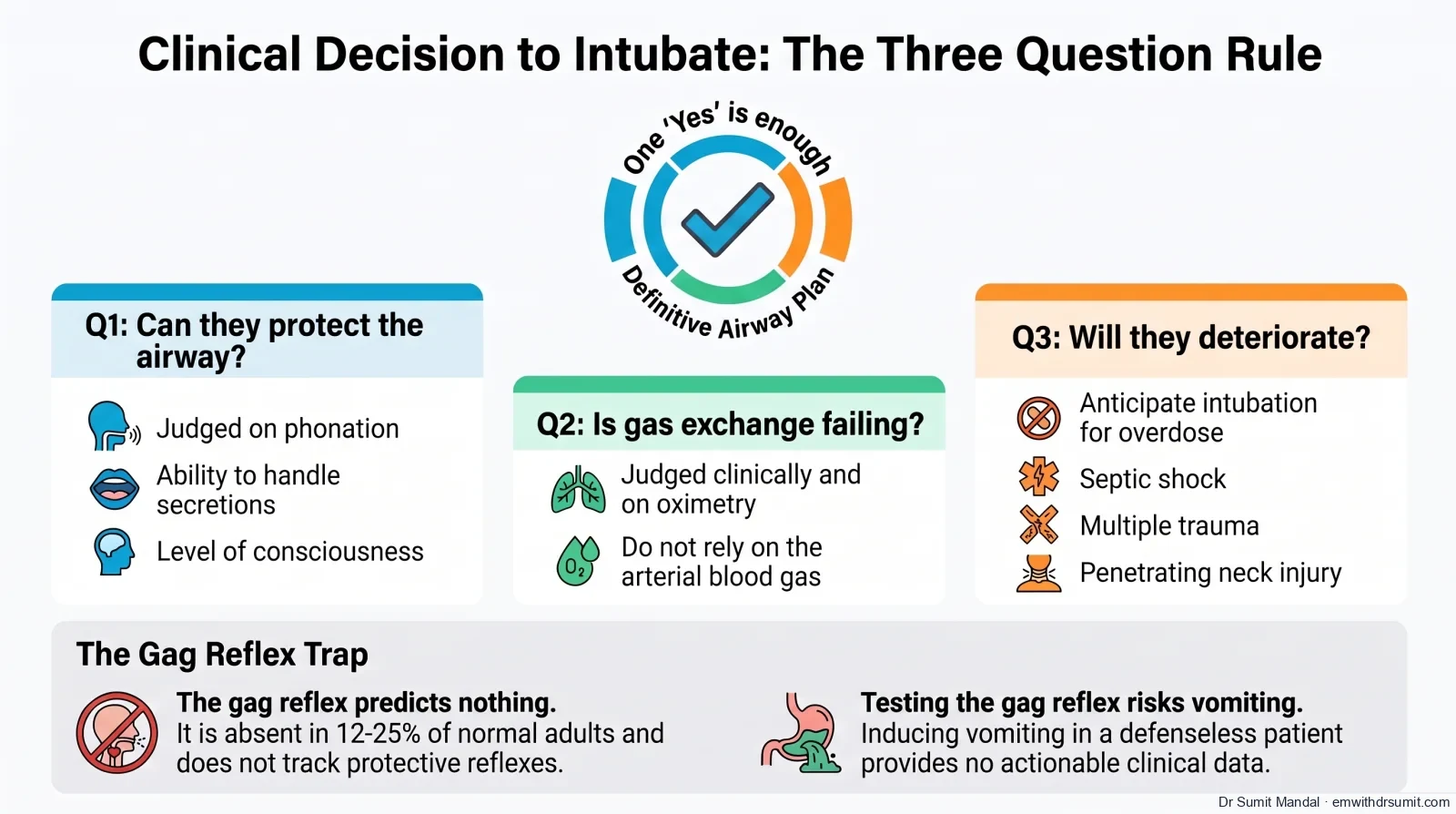
Decision to intubate
Three questions. One yes is enough.
- Q1Can they protect the airway? Judge on phonation, secretions and consciousness.
- Q2Is gas exchange failing? Clinical picture and oximetry, not the blood gas.
- Q3Will it deteriorate? Overdose, septic shock, multiple trauma, penetrating neck injury.
⚠Trap. Testing the gag reflex. It is absent in 12-25% of normal adults and predicts nothing, and the test itself can make a defenceless patient vomit.
🇮🇳The commonest Q3 here is the transfer: an ambulance, two hours of road, one attendant and no capnograph. Decide before loading, not at the district border.
 ⤢ Open full size
02
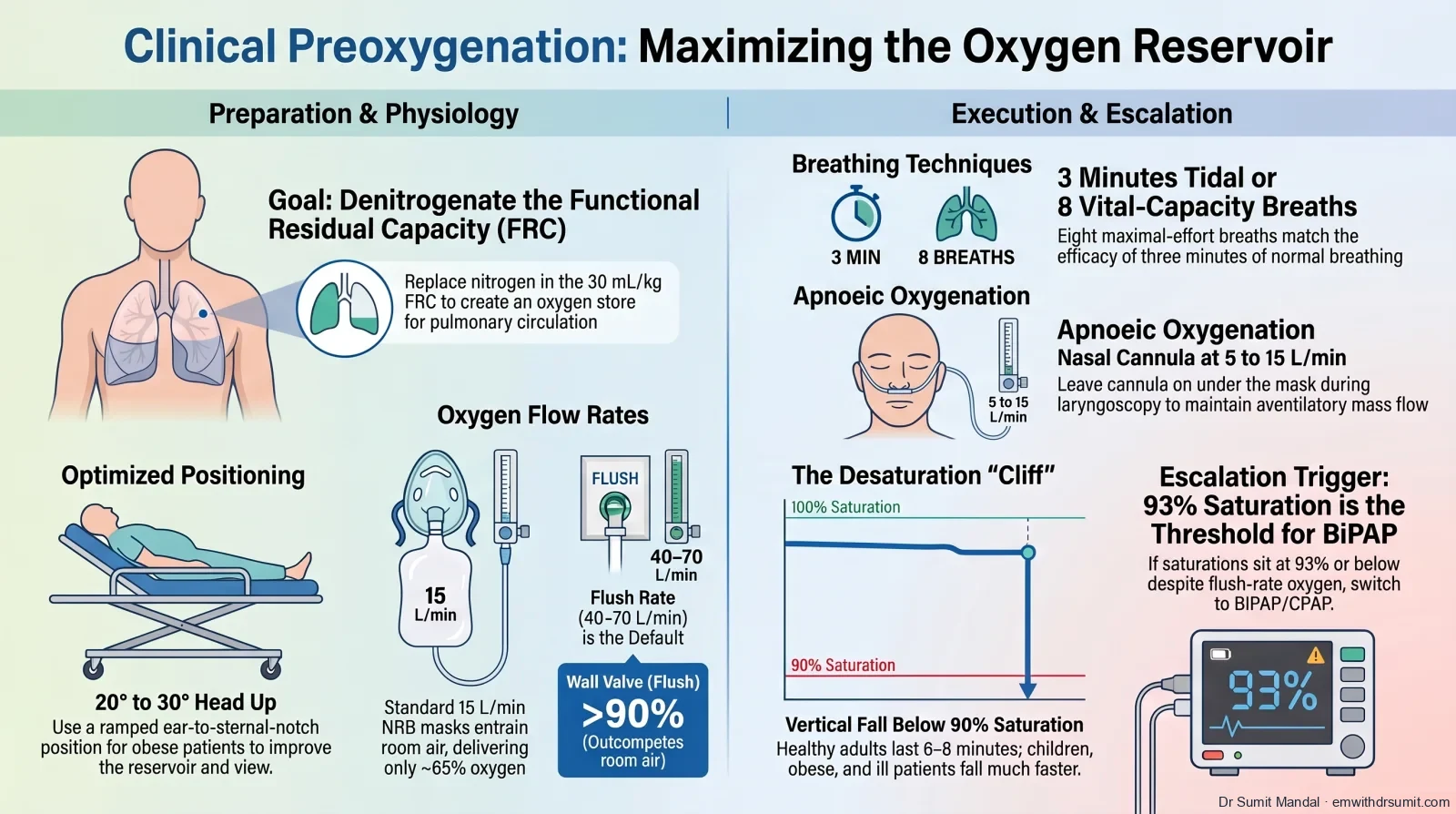
Preoxygenation
You are filling a 30 mL/kg reservoir, not 'putting some oxygen on'.
- whyYou are denitrogenating a 30 mL/kg reservoir, not just applying oxygen.
- flowA non-rebreather at 15 L delivers only about 65%. Open the wall valve to flush rate, 40-70 L/min.
- timeThree minutes of tidal breathing, or eight vital-capacity breaths when there is no time.
- ≤93%Saturation stuck at 93% or below is shunt — move to BiPAP, not more flow.
- apnoeicNasal cannula 5-15 L left running through laryngoscopy. In the obese it buys about two extra minutes.
⚠Trap. Leaving the non-rebreather at 15 L. That entrains room air and delivers only about 65% oxygen — open the wall valve fully to flush rate, 40-70 L/min.
🇮🇳The free half works everywhere: flush-rate oxygen, a head-up trolley, and a nasal cannula at 15 L left running under the mask through laryngoscopy.
 ⤢ Open full size
03
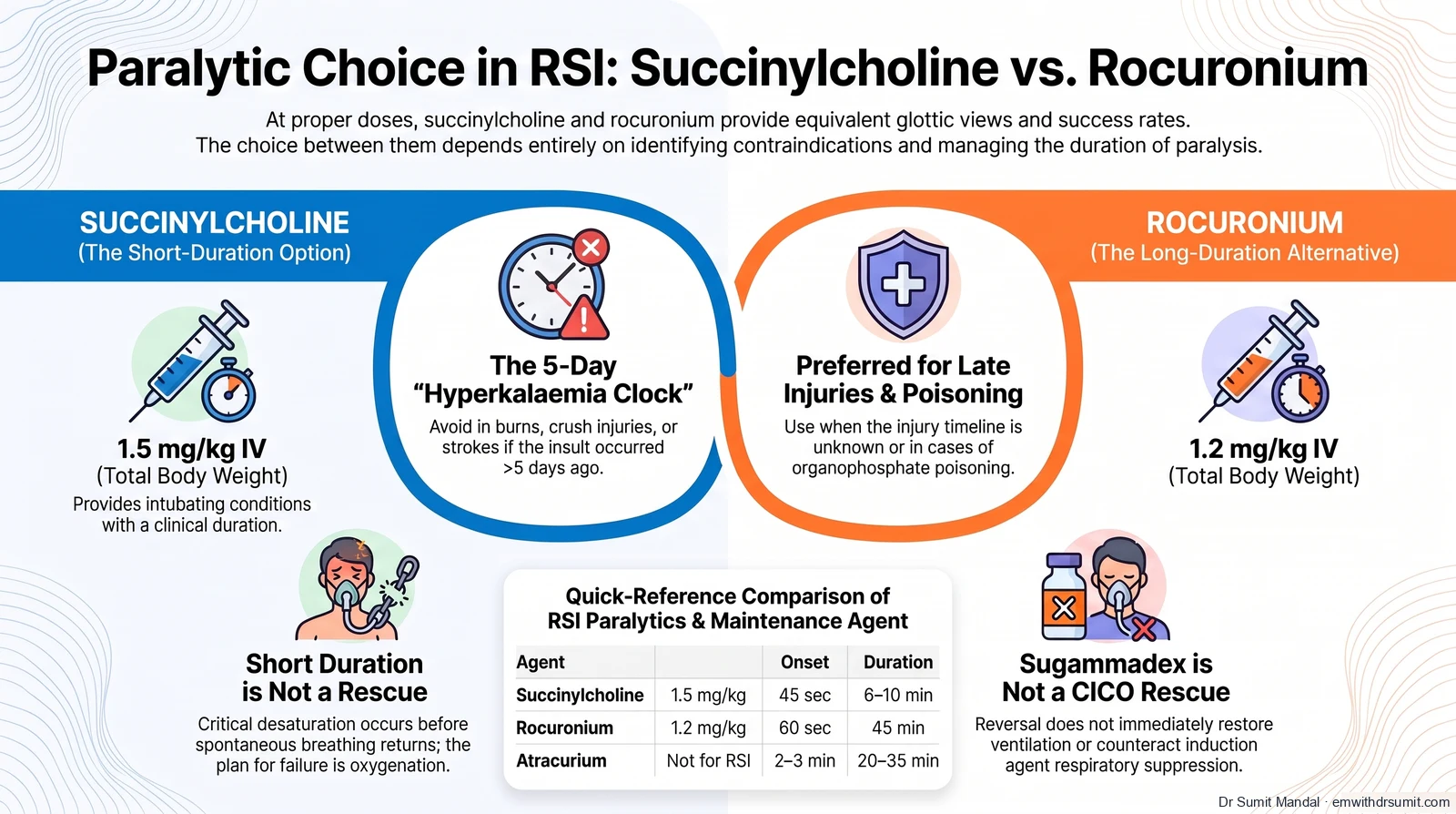
Which paralytic
Two RSI drugs, equal at proper doses. Atracurium is for after the tube.
Succinylcholine
Rocuronium
Atracurium
Role
RSI
RSI
Maintenance only
Dose
1.5 mg/kg TBW
1.2 mg/kg TBW
0.5 mg/kg
Onset
~45 s
~60 s
2-3 min
Duration
6-10 min
~45 min
20-35 min
Blocked by
The 5-day clock
Nothing absolute
Asthma, shock
Cleared by
Plasma cholinesterase
Liver
Neither — Hofmann
⚠Trap. Treating succinylcholine's short duration as a rescue. Critical desaturation arrives before spontaneous breathing returns — the plan for failure is oxygenation, not waiting.
🇮🇳The two contraindications you will actually meet are organophosphate poisoning, where plasma cholinesterase is already inhibited, and the missed-dialysis patient whose ECG already shows hyperkalaemia. In a government hospital atracurium is often the cheapest relaxant and the only one on the shelf — it is still not an RSI drug, it must be kept at 2-8°C, and it is incompatible in the line with thiopentone.
 ⤢ Open full size
04
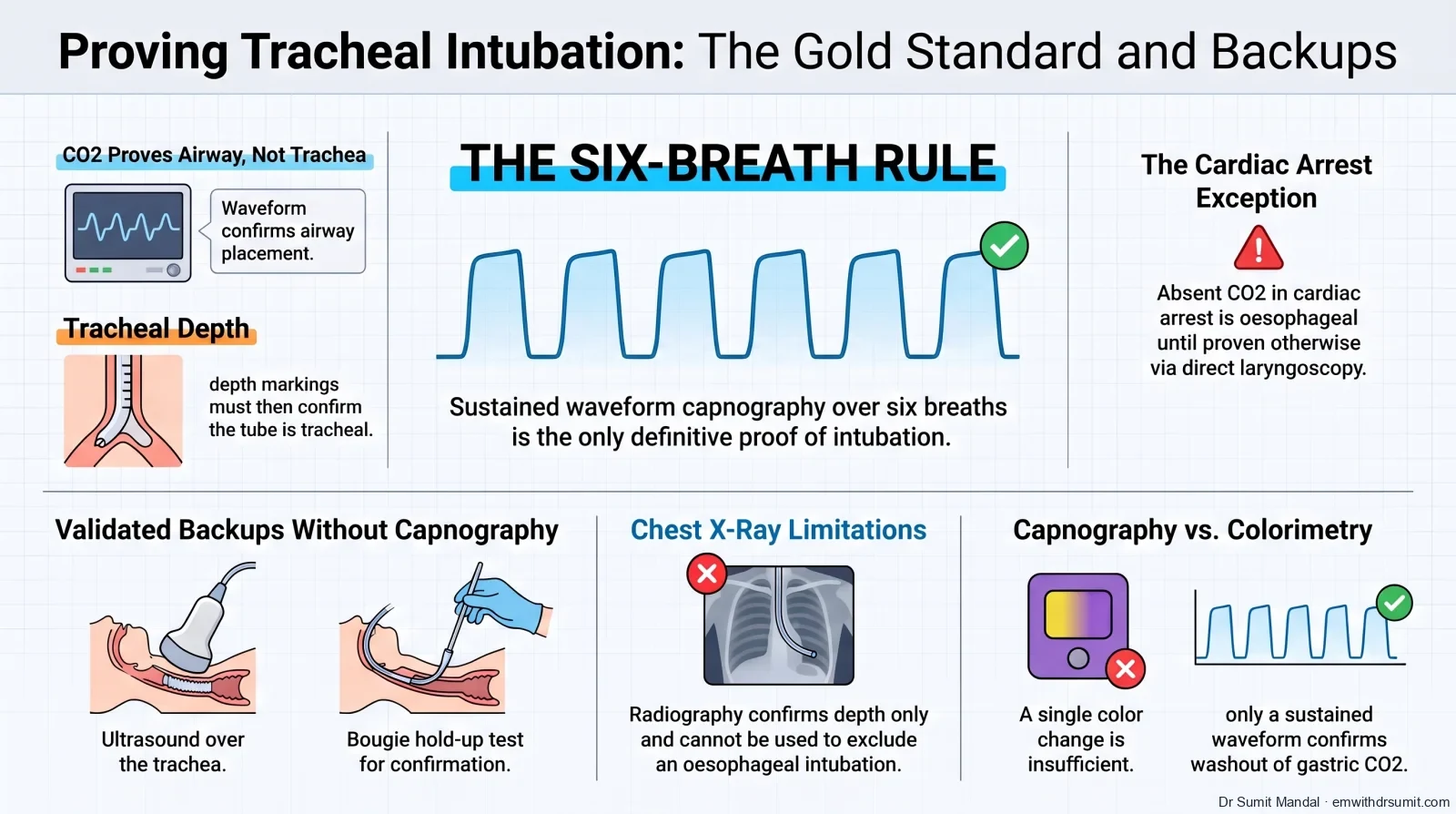
Proving the tube
Waveform over six breaths is the proof. Everything else is backup.
- 1Sustained ETCO2 over six manual breaths — one blip is not a confirmed tube.
- 2Then check depth: CO2 also appears with a mainstem or supraglottic tube.
- 3No capnograph? Ultrasound over the trachea, or the bougie hold-up test.
- 4The chest film is for depth only — it cannot exclude an oesophageal tube.
⚠Trap. Reasoning your way out of an absent waveform in cardiac arrest. Absent CO2 means oesophageal until proven otherwise — look again with the laryngoscope.
🇮🇳Ultrasound is available in far more Indian EDs than a working capnograph, which makes it a real confirmation tool here rather than an academic one.
 ⤢ Open full size
05
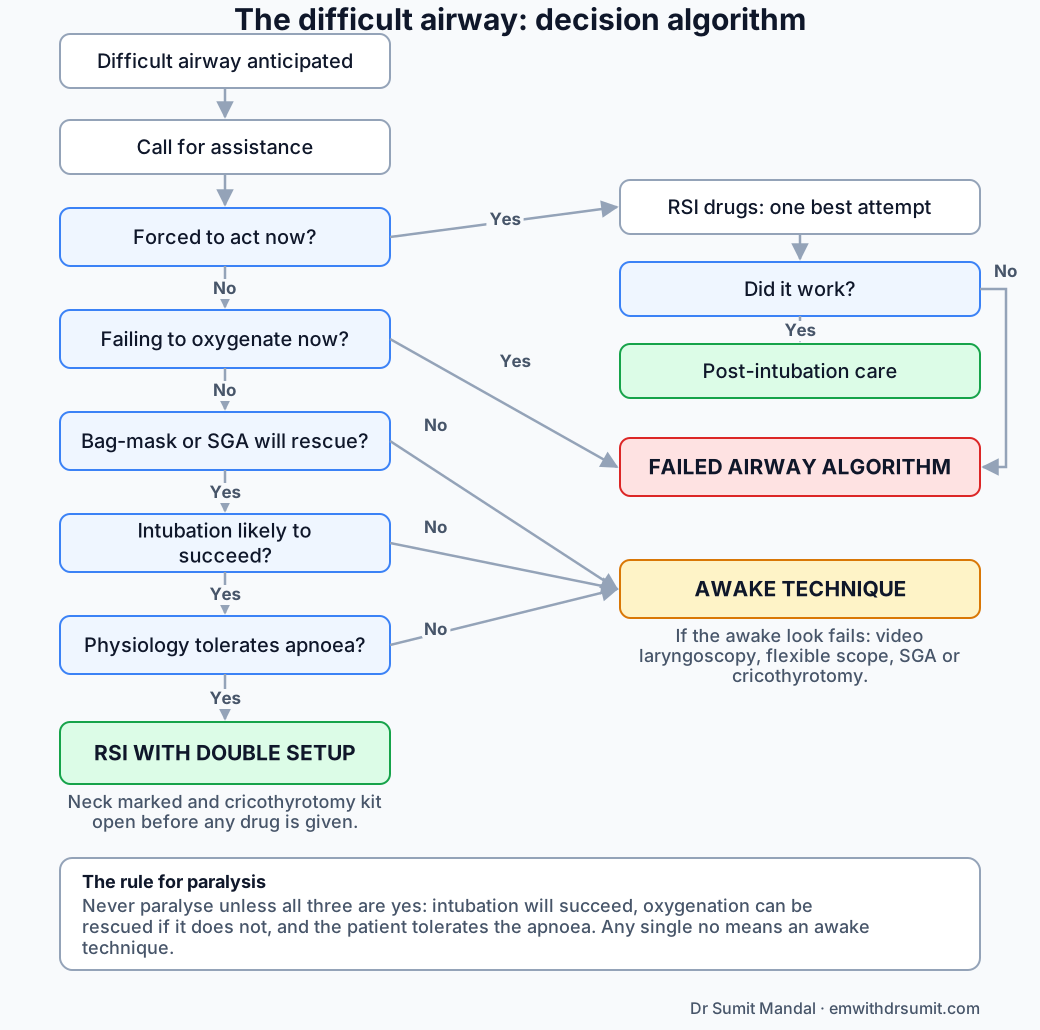
The difficult airway
Do not paralyse unless all three answers are yes.
- 1Is intubation likely to succeed?
- 2If it fails, can you oxygenate by mask or supraglottic device?
- 3Will the patient survive the apnoea and the induction agent?
- noAny 'no' means an awake technique — the patient keeps breathing.
⚠Trap. Reading difficulty as anatomy only. Refractory hypoxaemia, severe acidosis and vasoplegic shock make an anatomically easy airway dangerous, and none of it is visible from the end of the trolley.
🇮🇳These algorithms open with 'call for assistance'. At 2 am with one doctor there is nobody to call, so the effort shifts earlier: prepare the double setup on more patients than a teaching hospital would.
 ⤢ Open full size
06
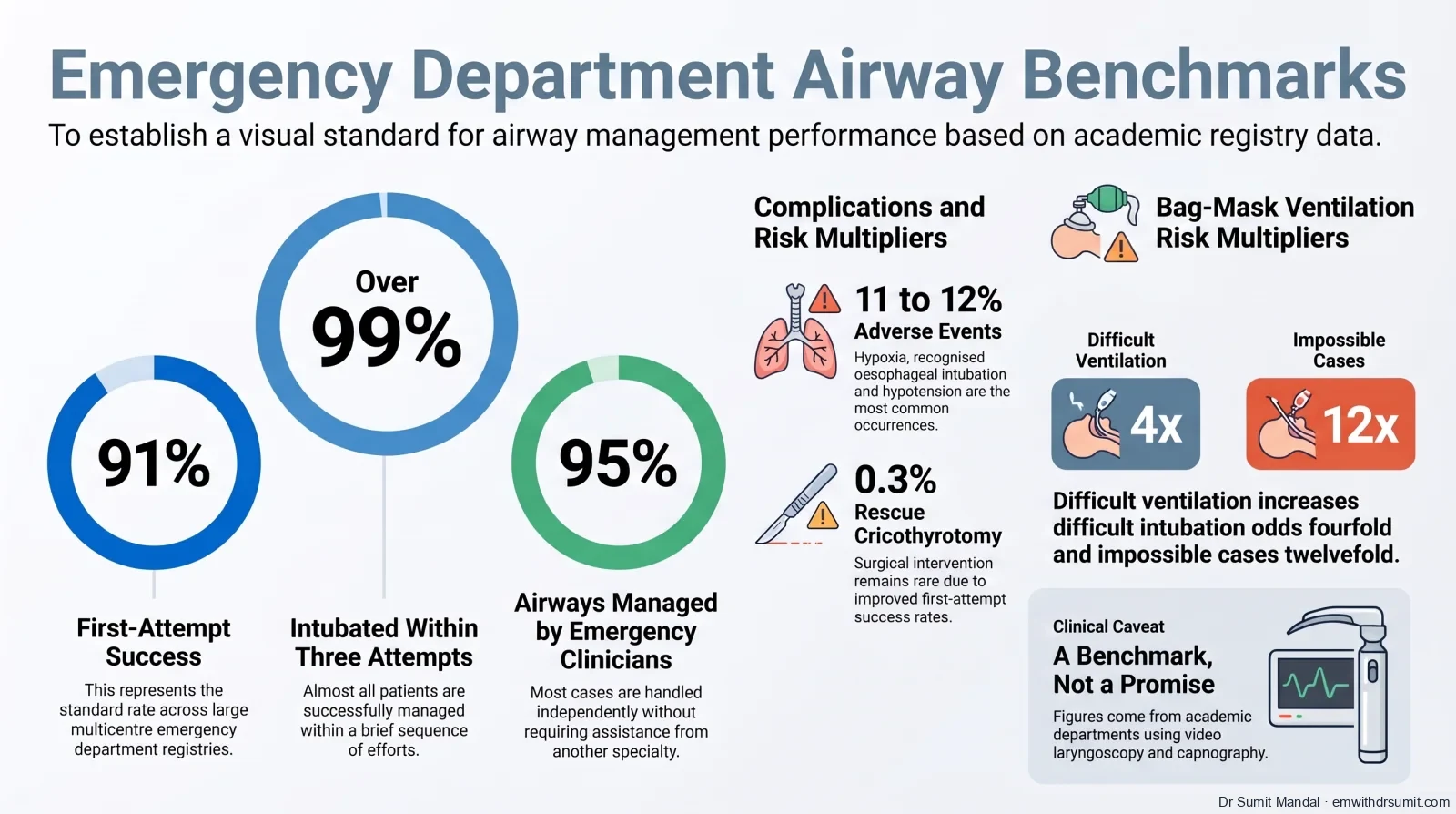
The benchmarks
You cannot tell it is going badly unless you know what going well looks like.
>99%
intubated within 3 attempts
0.3%
rescue cricothyrotomy
⚠Trap. Reading these as your own numbers. They come from academic departments with video laryngoscopy, capnography and a second airway-trained doctor nearby.
🇮🇳Measure your own four: first-attempt success, desaturation below 90%, hypotension after induction, and recognised oesophageal intubations. One page, reviewed monthly.
 ⤢ Open full size
There are 16 more cards in this chapter
The full set covers the crash and failed-airway algorithms, the RSI clock, induction agents, device choice, rescue oxygenation, cricothyrotomy and the airway with a cervical spine at risk — plus the whole study chapter behind it, with the evidence, the doses and the decision trees in full.
Free to create an account. Built for Indian emergency departments by Dr Sumit Kumar Mandal, Emergency Physician.
Revision cards are a recall aid, not the reference. Doses, evidence and the full decision trees live in the study chapter. Infographics are generated with AI from the chapter text, then reviewed and corrected by Dr Sumit Mandal.